| OLIVES
IN TUSCANY
By Sarah Brannen "Go ahead!"
we say. "Try one!" But something in our faces warns the novice
olive-pickers and they take only the merest, tiniest nibble
of the luscious-looking purple fruit; it's almost unbelievably
bitter. They complain and make horrible faces while we hang
from the branches and laugh. By the time they sit down to lunch on the
terrace though, eating trofie (twisty little pasta)
drowned in pesto and drinking pale yellow Sorbus wine, they've
forgiven us. We soak up the November sun and tell stories
of earlier harvests before heading back to the groves to pick
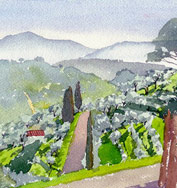
another sixty kilos. Eight years ago, my family bought a ruined
farmhouse on a steep hillside in northern Tuscany. It came
with six acres of rolling brambles and ivy, which turned out
to be an olive grove that had been abandoned for thirty years.
At the time, we barely gave the trees a thought. We hired
a crew to build a road through the groves and rip out the
undergrowth. When the ivy was gone, we discovered horribly
overgrown and neglected olive trees forty feet tall, desperately
trying to find the sun. The men hacked at them with chainsaws,
and we turned our attention to the renovations of the house
and terraces and forgot about the trees until the following
November. Then the poor trees put forth olives in
surprising numbers. Our Italian friends and neighbors showed
us how to pick them, and we carried a few bags down to the
local olive mill. That night, when we first tasted the bright
green, peppery, intense oil, thin and not at all "oily," an
obsession was born. Now as many of us who can find the time
make the pilgrimage to Campitino each November. We rope in
various unsuspecting friends and relatives who think that
picking olives in Tuscany sounds like a relaxing vacation.
We always know the true olive-pickers when they ask to come
back next year! (We've reached the point of having to turn
people away). Olive trees are evergreen, with leaves that
are gray-green on top and silvery pale green below. When it's
cold, the trees turn the dark side up to absorb the heat of
the sun, and when it's hot, they turn the light side up to
reflect it and the groves gleam in the sun. The branches fruit
on second-year growth; the olives either run the length of
the branch or cluster at the end, depending on the kind of
tree. There are hundreds of varieties of olive trees throughout
the Mediterranean. Some are grown for eating, others for pressing
into oil. In Tuscany, most trees are either the frantoio
or leccino variety; we also planted an eating olive,
Santa Caterina, last year. Like most Americans, I used to imagine
that green olives grew on one kind of tree and black on another.
In fact, all olives start green and turn black or purple when
ripe. Then they dry and shrivel a bit, at which time they
yield the most oil. But the flavor is more intense when the
olives are not completely ripe, so the earlier one picks the
stronger the flavor. In Tuscany, people tend to harvest earlier
than in other Mediterranean areas. We like our oil strong
so we usually start picking in the last week of October. We dress in old clothes and boots and wear
leather gloves. If you accidentally sit on a drift of olives,
the oil in the fruit squashes out and stains your pants pretty
thoroughly. When the olives are not completely ripe, they
have to be stripped off the branches with a motion called
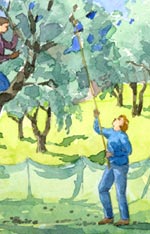
"milking." It can be hard on your hands. We spread a big,
fine-meshed net below the tree we're going to pick, and lift
the edges on stakes to make a basket. Each spring we try to
prune the trees down to a reasonable height so that some people
can pick from the ground at harvest time. Others climb the
trees and pick from within, or go up ladders to reach the
highest fruit. We strip the olives off the branches and knock
the unreachable ones down with bamboo poles. They fall on
the net, (and down our necks) and when we're done with a tree
we gather up the net and pour the olives into stacking crates. We used to gather them in heavy burlap bags
which were a lot more picturesque, but last year
we caved in to the modern era and bought eighteen plastic crates.
I'm a tree-climber. I'm never happier than when I'm high in
an olive tree, looking across the Tuscan landscape and listening
to the birds singing. (I have been known to sing too). On the
other hand, there are also ants in some of the older trees,
and I've been bitten enough to name one tree "Ant." The ants
are small, and when they get riled up they raise their abdomens
over their heads, like tiny scorpions. And they hurt when they
bite! Other people can pick Ant from now on.
Yes, I'm afraid we name our trees. I'm not sure how it started,
but every picker now gets naming privileges for one tree.
"Sarah" is my favorite tree to climb, with branches like stairs
to the top and a sort of branch armchair to relax in when
you get there. "Buz," my father's big tree, is named in commemoration
of a famous fall he took a few years ago, which was acted
out later, with a chair, at holiday gatherings. "Turkey-lurkey"
is named after one of our neighbors, I'm afraid. Another neighbor,
the Rabbit Man, will no doubt have his own tree eventually. At the end of a day's picking, we carry
the olives up to the cleaned and swept garage and spread them
on another net. Olives, although they seem hard and firm,
are fragile. If they are left in the crates, they would bruise
and rot. Finally we head to the house for showers, usually
discovering another dozen olives in our clothes and boots. The local olive mills require between 250
and 350 kilos of olives each time they send a batch through
the press. With five or six people picking it usually takes
us three days to gather enough for a pressing. On the last
day, when the garage floor is filled with olives, we loiter
around admiring them. The colors range from pale green to
luscious reddish purple to black with a bluish bloom. Although
one olive doesn't have a perceptible smell, en masse they
have a thrilling spicy scent, similar to the smell of fresh
olive wood. We load them in the car and take them to
the olive mill at the bottom of the hill. In the old days,
a donkey pulled two enormous grinding stones to crush the
olives. Although electricity provides the power now, the stones
are virtually identical to those of a thousand years ago.
In every other way though, modern ways have eclipsed the old.
The regulations for the traditional "cold press" method, in
which the ground olives are spread on a tower of mats, with
the oil squeezed out by a hydraulic press and skimmed by hand,
have become so stringent that most mills have switched to
using a centrifuge-driven, closed system. It's not as picturesque,
but it's more hygienic and frankly I can't taste any difference
in the oil. And the smell in the mill is the same as it's
always been, overpowering, intense, and somehow green. We're very proud of our olives. Our groves
are situated perfectly, as it happens, high enough but not
too high, facing south, close enough to the ocean but not
too close. Our olives are usually spectacular, free of the
dread olive-fly larva, fat and perfect. The other farmers
waiting at the mill run their fingers through them and talk
about them, and ask us where they're from. We usually get between thirty and thirty-five
liters of oil from each pressing. In our best year we picked
1360 kilos of olives, about a ton and a half, and got 172
liters of oil. And we couldn't pick them all that year, not
even close. We're still not sure how much oil we would end
up with if we picked every olive. Back at Campitino we indulge ourselves,
dipping bread in bowls of oil, comparing different pressings.
The oil is at its strongest for the first month; after that
it's good, but never the same. We make zuppa
frantoiana,"olive-mill" soup with garlic toast floating
on top amid droplets of the new oil, made everywhere in Tuscany
during the olive harvest and at no other time. Don't let me mislead you; it's not always
as good as it sounds. Sometimes we have weeks of t-shirt weather
when we eat lunch outside on the terrace every day. But November
is a rainy month in Tuscany, and sometimes we have to spend
time shopping and museum-going instead of picking. The infernally hot summer of 2003 led to
our first olive-fly infestation. The crop was poor and every
olive had a little white resident. (Apparently the weather
was extremely good for the grapes, so there may be future
compensation in the wine cellar). Somehow, though, we always remember the
good things. Pecorino cheese, cinghiale salame, Il Trovatore
in the opera house in Lucca, walks in the chestnut woods.
The time always seems to have evaporated as we drive down
the hill for the last time toward the airport in Florence,
lugging five-liter jugs of oil to explain through security.
At home that night, in my own bed again, I close my eyes and
see olives.
|