| AXE
UPON AXE: The Story of Hezekiah’s Tunnel
By Joy
Nelkin Wieder
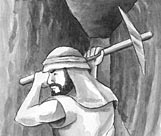
The miner’s muscles tensed as he hammered
desperately at the limestone. The enemy would soon surround
Jerusalem, cutting off the city’s water supply. Stone
chips flew as his pickaxe carved through the bedrock, toward
the spring and its life-giving water. Suddenly he heard a
voice on the other side of the rock. “Halt!” he cried out to the
other miners on his team. “I hear something…someone.” The other workers stopped swinging their
axes, straining to hear. They, too, heard muffled sounds and
called out to the miners on the other side: “We are here!” “Can you hear us?” Following the sounds on the other side
of the rock, they worked toward the other team, hewing the
rock as quickly as they could. Finally, they broke through
to the other side and the two teams became one. The tunnel
connecting the Gihon spring to the Siloam Pool was complete,
bringing much needed water to a city on the verge of war. This is how King Hezekiah’s tunnel
was built over 2,700 years ago. How do we know this is true? When the historic
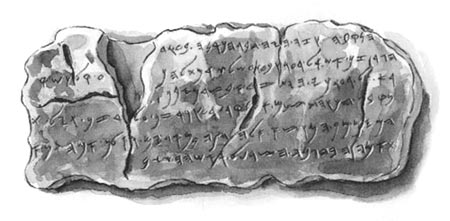
tunnel was rediscovered in 1880, archeologists found an inscription
in the tunnel wall, a few paces from the pool. Written in
ancient Hebrew, it described how the tunnel was carved out
of the solid rock by two teams of miners, starting at opposite
ends. The Turkish government pried out the rock
containing the inscription and put it on display in the Istanbul
Archeological Museum. A copy of the inscription is on display
in Israel.
When archeologists inspected further, they noticed that axe
marks still engraved the inside of the tunnel walls. The marks
pointed toward each other from opposite ends: the axe marks
from the spring pointed toward the pool and the marks from
the pool pointed toward the spring! The
1,760-foot tunnel was carved through solid rock with only
hand-held tools such as hammers, wedges and pickaxes. It
is one of the greatest engineering feats of the ancient
world. Experts estimate that it took six to nine months
to complete.
Why was the tunnel built? When Hezekiah reigned
in Jerusalem, the mighty Assyrian Empire sought to rule
over the entire Middle East. Assyria had already conquered
many civilizations including Babylon and the Northern Kingdom
of Israel. In those days, high stone walls surrounded major
cities like Jerusalem. Conquering armies would besiege
a city, completely surrounding the walls thus cutting off
supplies such as food and water. In a desert climate like
Jerusalem, water is crucial to survival. The city’s main source of water was the Gihon, a spring
outside the city walls. If the Assyrians surrounded Jerusalem,
they would cut off access to the water. Hezekiah’s tunnel
connected the spring to the city’s reservoir, the Siloam
Pool, which was inside the thick wall.
Since the Assyrians had already
invaded his land, King Hezekiah had to complete the tunnel
as quickly as possible. He did something so outrageous that
experts today cannot understand how it was accomplished.
Hezekiah ordered two teams of miners to dig the tunnel, one
from the Gihon spring and one from the Siloam Pool. It must
have taken a miracle for the two teams, digging through solid
rock from opposite directions, to meet in the middle!
Hezekiah’s tunnel has many twists and turns. Why didn’t
they simply dig a straight line? The limestone beneath Jerusalem
contains a Karst system, water-carved caves sprinkled throughout
the bedrock. Hezekiah’s engineers connected these existing
caves like a giant dot-to-dot puzzle. They made use of what
was there to speed the completion of the tunnel.
Hezekiah
may have been inspired by his great, great, great, great
grandfather, King David. When David wanted to capture Jerusalem,
it was a heavily fortified city set on the ridge of a mountain.
With Jerusalem surrounded by high walls and deep valleys,
David knew he couldn't take it by force.
David’s commander, Joab, found an
aqueduct carved into the mountain. It ran from the Gihon spring
outside the city walls right into the heart of Jerusalem.
David sent a small force of his best men to crawl through
the aqueduct. Then they had to climb straight up a deep well
to get into Jerusalem. Quietly, they opened the East Gate
of the city where David and the rest of his army were waiting
in a narrow valley. David took the enemy by surprise and captured
the city without bloodshed. He made Jerusalem his capitol,
and it became both the political and religious center of the
Israelite kingdom. Afterwards, the aqueduct was used to water
the king’s gardens, but eventually fell into disrepair.
By Hezekiah’s time, it had become completely unusable.
Hezekiah had to build a new tunnel to bring the sweet water
of the Gihon into his beloved city.
Hezekiah’s tunnel has survived to this day, little changed
since it was first carved out of the Jerusalem bedrock. Adventure-seekers
can travel the entire length of this ancient wonder –
approximately six football fields laid end to end. Guides
lead visitors through winding turns, often ducking to bypass
outcrops in the bedrock and splashing through the knee-high
spring water. It’s an adventure of a lifetime!
The inscription reads:
"The tunnel is completed. And this is the story of
the tunnel: As the miners were still waving the axe, one in
the direction of the other, and as there remained three cubits
(4 ½ feet) to be cut through, there was heard
the voice of one calling to the other that there was a hole
in the rock on the right hand and on the left hand. And on the
day of the completion of the tunnel, the miners met each other,
axe upon axe. Then the water poured from the spring to the pool
twelve hundred cubits (600 yards), and one hundred
cubits (200 yards) was the height of the rock above
the heads of the workers in the tunnel."
Learn
more about Hezekiah’s tunnel
Take
a virtual tour of the tunnel
Joy Nelkin Wieder is the author/illustrator
of “The
Secret Tunnel,” a Fun-to-Read book
for children seven to ten years.

|